

If you’ve been publishing blogs and articles for months without seeing any results, let alone conversions, the fault might not be in the content copy you publish. Oftentimes, businesses link leads to traffic acquisition and the number of posts with traffic. This is not always the case if you don’t utilise strategy in your workflow.
Even by adapting state-of-the-art tools and AI software and employing excellent writers, if there’s no structure, no behind-the-scenes blueprint & no strategy in place, these posts scatter in isolation, contributing only to mindless population.
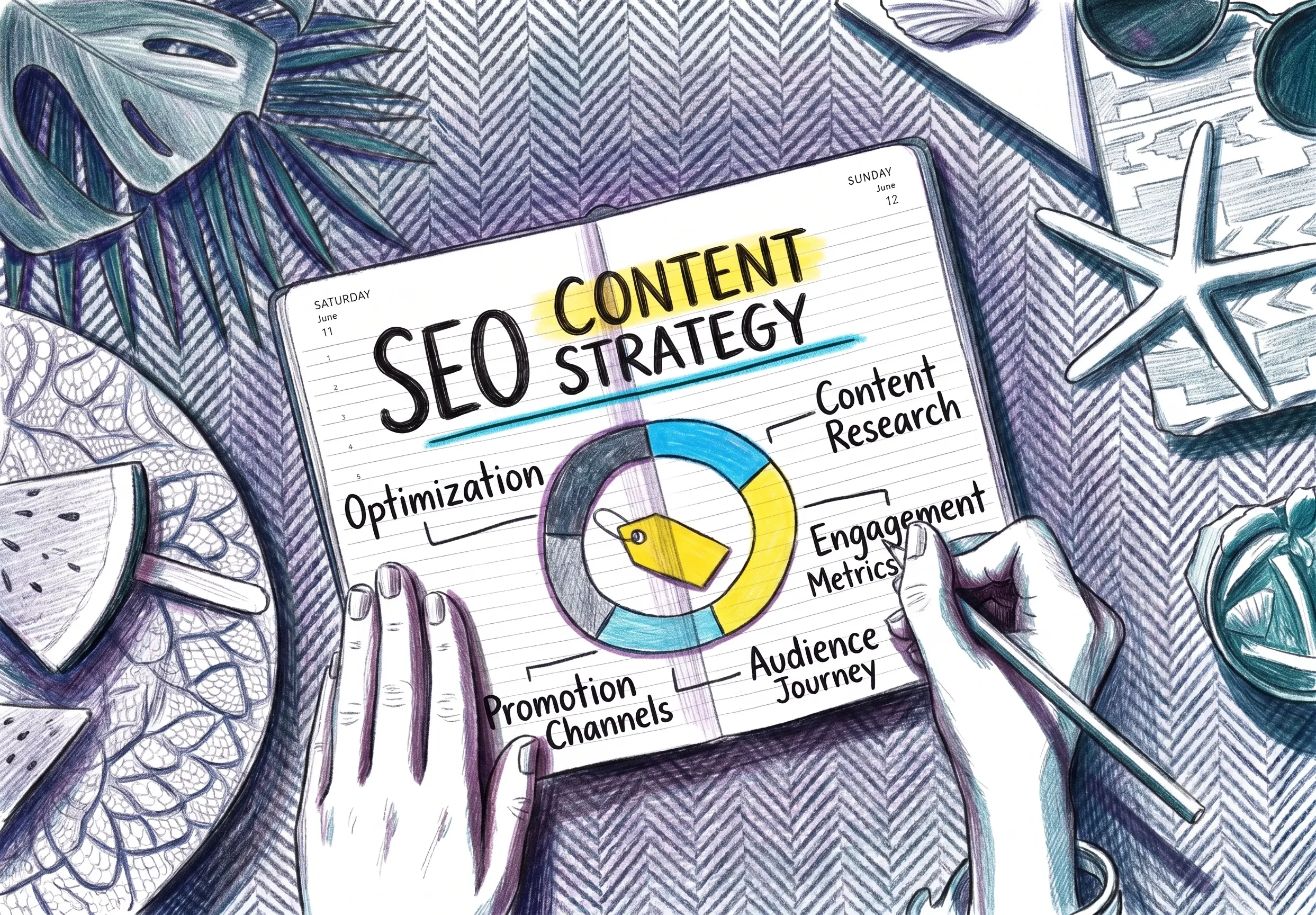
One such important factor in content writing is content strategy, of which SEO content strategy takes the crown. It’s the initial blueprint that serves as a building block for content strategy, where you align the intent to the audience, naturally selecting keywords that contribute to the cause. In addition to guaranteeing ranking on search engines and AI, SEO content strategy serves as a writer’s guidance – providing them with an optimised outline & cover on what to do and avoid. It’s the only aspect that makes the difference between a good written blog and a great one that drives traffic and business goals.
This is a challenge many businesses unknowingly create for themselves. They focus on creating more content rather than building a system in which every post/article contributes to a larger purpose.
Rather than asking “what we should publish next?”, we should start asking “what are we trying to achieve, and who is it going to help?” When the intent, audience, and business goals are aligned, no force in the world can prevent you from writing an exceptional value-driven post.
This blog is created for exactly that. We’ll help you know how you can create an SEO content strategy that supports long-term growth, build authority within your niche, and turn every new blog post into a stepping stone towards sustainable business success.
Let’s get into it.
Why Most SEO Content Strategies Fail Before They Even Begin
Before we move on to why this fails, let us understand what SEO content strategy means.
SEO content strategy is the plan that ensures the goal, intent, and audiences’ needs are aligned, following best SEO and E-E-A-T practices in a logical manner that eventually serves as a blueprint for content writing, internal linking & future post creation – forming a closed loop of feedback and refinement, where every aspect is governed by expertise morphed into what’s known as a comprehensive SEO content strategy.
Sounds complicated??
Well… to put it simply, it means having a plan that can help your post rank not only in search engines and AI, but also attract the right audience, generate leads, and bring enquiries – consistently pushing your business towards sustainable success.
Now, let’s get into why this fails even before you begin.
Most content strategists start with isolated keyword targeting. They select a keyword solely based on volume, forgetting the ‘why’ behind it. When you do so, you are targeting all the casual browsers rather than your audience. This means that even if your traffic increases, you’re not essentially generating leads, enquiries, or real business opportunities.
Another core planning mistake that weakens your strategy is measuring the wrong KPIs (Key Performance Indicators). When you’re a new website or aiming to improve brand awareness, your KPIs should include organic impressions, brand mentions, engagement time, and organic traffic. Likewise, if your goal is lead generation, your KPIs should focus on qualified enquiries, form submissions, consultation bookings, and conversion rate.
- Accordingly, you should strategise and plan your content calendar once you have a clear understanding of the audience, their needs and pain points, the intent you want to cover, and the ultimate objective.
The third mistake is treating every article/post as a standalone project.
Publishing random articles just because they’re trending or your competitors are writing is one of the fastest (and dumbest) ways to weaken your topical authority. This not only leads to thin content creation, but also undermines your authority, turning your website into a general resource: ‘just another fish in the pond’.
The fourth mistake is ignoring internal linking. Again, this traces back to cluster creation rather than standalone articles. When you have a library of interconnected posts & they are linked naturally – you form a web of content that acts as a system in signalling the crawlers & bots that you are an expert.
Ignoring internal linking breaks this connection, causing both users and search engines to see only the smaller picture instead of the complete topic.
Once you start taking control from the core planning phase by aligning intent with keywords, then going for clustering and linking, and finally measuring the right KPIs, your SEO content strategy will never fail.
Start with Business Goals, Not Blog Ideas
Once you’ve decided to build an SEO content strategy, jumping straight into brainstorming blog ideas or keyword research is not the right place to start.
You should begin by understanding what you’re trying to achieve, and whether the topic or keyword you choose will work towards it. As seen earlier, without context and a foundation in place, creating content solely for the sake of publishing will only make your website seem like another fish in the pond.
In fact, even before you decide on the intent, ask yourself a simple question: “What would this content help the business achieve?” Whatever your goals are (be it lead generation, organic traffic, engagement, etc), it should shape every content decision that follows.
Let’s understand with an example:
XYZ Interiors is a residential interior design studio looking to grow its online presence and get leads. It decides to go with the trend by publishing blogs around topics like “Living Room Design Trends for 2026″ or “Top Interior Design Styles.”Now this may be a good move if the studio is trying to gain traffic. But since the ultimate goal is lead generation, these trendy topics will probably not deliver the result they are aiming for.
Though they might get significant traffic from such topics, they wouldn’t necessarily attract potential customers who are looking to hire an interior designer.
But if the team reassesses its approach and asks itself, “What kind of customers do we want to attract?” it can now change its direction effortlessly.
XYZ Interiors can now create topics that support its goals. Ex:
- How to Choose the Right Interior Designer for Your Home
- How Much Does Home Interior Design Cost?
- Common Mistakes to Avoid Before Renovating Your Home
It’s not that you don’t need to keep up with trends; you do. In fact, it’s one of the significant factors in establishing your E-E-A-T (Experience, Expertise, Authority, Trustworthiness). Have it at a ratio of 3:2, where 3 are topics around your goals, and 2 are trendy or evergreen topics.
Focus on your goals even before search intent. Think of it as the first necessary step in the proper execution of an SEO content strategy.
Understand Your Audience Before Planning Content
Once your business goals are clear, the next step is understanding your audience’s needs, pain points, what they are looking for, their psychographic behaviour, what motivates them, and what causes hitch – In short, you need a clear understanding of your Ideal Customer Profile (ICP).
Let’s continue with the XYZ Interiors example.
- Since the team has already established its goal as lead generation and finalised the topics it wants to dive into, the next step is understanding the audience behind those topics. This ensures the topic is covered from different angles, addressing audiences’ needs across every stage of the customer journey.
- The studio finds that most enquiries come from first-time homeowners planning a renovation. It can now plan content that addresses the renovation journey – from ideas and inspirations, to comparing providers based on a budget, what they should look for before hiring, and the timeline they can expect.
This approach allows XYZ Interiors to plan and create relevant content that helps users move closer to making a decision.
Understanding your audience doesn’t just improve the quality of your content— it also helps answer their queries across different stages, guiding them organically towards commercial-transactional decision-making.
Related Readings: Before creating content, learn how to identify the purpose behind every search with our Search Intent in SEO Guide
Build Your SEO Content Strategy
Once you’re done with the goal identification and mapping the audience’s needs, it’s time to build your SEO Content Strategy. Now, this can either be short-term or long-term, and this distinction is very important.
Let us understand the distinctions in simple terms.
- Short-term Strategy: Here, you take on low-volume keywords and queries and write content around them. This can even include writing trendy topics & industry update posts. It also includes updating existing content and fixing technical errors.
- Long-term strategy: Here you target high-volume, competitive keywords & queries, building clusters around them, and earning authoritative backlinks. This type of strategy usually spans months to show the compounded result.
The right approach is to use a balance of them, where quick results involve short-term planning – targeting specific keywords relevant to you- while at the backend you consistently target high-volume keywords and work on them. This eventually forms the backbone of organic traffic, establishing topical authority as a by-product.
Now, let’s get into building an SEO Content Strategy.
Step 1: Define Your Core Content Pillars
Content pillars are often broad topics that form the foundation of your SEO content strategy. Every blog, guide, case study, or landing page you create supports one of these pillars.
Let’s understand with the XYZ Interiors example.
Since the studio’s goal is to generate enquiries from homeowners planning a renovation, it should define broad content pillars that naturally allow related topics and supporting content to branch out from them.
Its content pillars might include:
- Home Renovation
- Interior Design Costs
- Space Planning
- Interior Design Tips
Each pillar represents a subject the business wants to build authority around. More importantly, each one aligns with what potential customers are looking for during their renovation journey.
Remember, choosing a pillar topic doesn’t always have to be trending or have a high search volume. If a topic doesn’t support your goals or help your audience, it doesn’t belong in your long-term strategy.
Before defining your content pillars, ask yourself:
- What products or services do you want to be known for?
- What topics genuinely showcase your expertise?
- What questions do your customers ask?
- And will these topics remain relevant over the long term?
Step 2: Validate Your Content Pillars with Keyword Research
Once your content pillars are established, it’s time to validate whether people are actually searching for them. This is where keyword research comes into the picture.
Let’s return to the studio example.
Since one of its pillar topics is ‘home renovation’, use tools like Semrush and Ahrefs to find out how customers are actually searching for it. You may find related terms that precede this seed keyword.
- Home renovation cost (Volume – 880, US)
- Home renovation checklist (Volume – 260, US)
- How long does a home renovation take? (Volume – 60, US)
- Renovation mistakes to avoid (Volume – 30, US)
Remember, these keywords are not replacing your pillar topic, rather strengthening it.
If you’re new to keyword research, refer to our “How to Do Keyword Research for SEO Guide” to learn how to find, analyse, and prioritize keywords.
Step 3: Expand Each Pillar into Supporting Topics
Now, take the related keywords (in step 2) and build topics for them
- How Much Does Home Renovation Cost?
- How to Plan a Home Renovation
- The Complete Home Renovation Checklist for First-Time Homeowners
- Top Home Renovation Mistakes to Avoid
Though each of these subtopics answers specific questions, together – while naturally connecting to the pillar page- they strengthen the topical authority. Over time, it begins ranking at the top on both search engines and AI, while also helping the target audiences.
Visitors can explore one page and naturally land on the next post. Now, you’ve formed a connected system, kind of like a library – where you provide supporting books to the pillar topic to cover it from all angles.
Learn how connected content helps businesses build expertise and improve organic visibility with our guide on – What Is Topical Authority in SEO and Why It Matters.
Step 4: Strengthen and Maintain Your Content
Publishing the content isn’t the last step – it’s the beginning for further optimization, adding structured data, updating to keep it relevant, and doing internal linking. Search behaviour changes and customer expectations evolve. Hence, you need to keep your existing content up to date so it meets the needs of today.
In fact, make it a habit to:
- Regularly review your important content
- Update information, stats, and examples
- Add links to newly published articles where relevant
- Refine content based on feedback and search trends
- Refresh metadata and keep the technical aspects in check.
An effective SEO content strategy is one where the web of content remains connected, accurate, and valuable over time.
Read our Complete Guide to SEO Content Writing to learn how you can create content that ranks, connects, and delivers long-term value.
Measure the Success of Your SEO Content Strategy
How will you know your content is performing or leading the visitors a step closer to your goal?
Many make the mistake of assuming measuring success means measuring rankings every single day. It’s not.
Success means visitors completing either your primary or secondary goals, or both.
For XYZ Interiors, who wanted enquiries, traffic measurement isn’t the final measure of success.
In addition to measuring traffic and rankings every week, the team also has to measure
- Engagement: Are visitors finding the content useful to explore further?
- Enquiries: Are visitors contacting XYZ Interior’s team?
- Qualified leads: Are those enquiries coming from people who are genuinely looking to hire an interior designer?
Even when their “Living Room Design Ideas” blog attracts more visitors compared to the “Home Renovation Costs” blog, but they are getting about eight enquiries a month from the cost blog, then the second blog is clearly a winner as it’s directly contributing to their primary goal.
This is why traffic alone isn’t a reliable measure of SEO success.
The right metric for measuring the success of your strategy depends on what you want the content to achieve.
Use tools like Google Search Console, Semrush Position Tracking, MS Clarity, and more to measure the performance of what’s working, what needs improvement, and where your content strategy should go next.
SEO Content Strategy in the Age of AI Search
Search is changing. People no longer search traditionally by typing in keywords; their search is now longer – in a query format, often directional and very specific.
Rather than searching “hire interior designer” — often those who are at this stage want a direct answer; they search “I’m planning to renovate my 3BHK home. How much should I budget, and what should I consider before starting?”
AI search can now summarise information, giving users exactly what they need and even answering their follow-up questions. Businesses now need to adopt a practical approach, combining the foundation of SEO with evolving needs of AI search and how content needs to be created.
For XYZ Interiors, the goal is still the same: attract enquiries. What changes is how these potential customers discover the content.
Someone might search Google for “How much does a home renovation cost?”, ask an AI tool the same question, or ask a follow-up such as “What should I budget for a 3-bedroom apartment?”
The studio can’t predict every variation. But what they can do is create genuinely helpful, practical content that demonstrates their experience and answers the underlying topic thoroughly.
That means your SEO content strategy should focus on:
- Answering real questions clearly
- Covering topics clearly and in-depth, rather than just touching the surface
- Demonstrating first-hand expertise
- Keeping content accurate and updated.
Common SEO Content Strategy Mistakes Businesses Make
Here are some of the most common mistakes to watch out for:
- Mistake 1: Publishing Without a Clear Business Goal
- How to Fix It: Establish your business’s primary and secondary goals and start from here. This gives you the direction on how to approach a topic and determine whether it’s worth the time.
- Mistake 2: Choosing Keywords Before Understanding the Topic
- How to Fix It: Search volume can be tempting, but a popular keyword isn’t automatically a valuable one for your business. Your keywords should align with your needs, goals, and audience profile
- Mistake 3: Creating Every Article in Isolation
- How to Fix It: You should consider a topic that effortlessly relates to the next one, often as a solution or practical guidance to the question that follows. This will help naturally link your articles/blogs, creating a web of information – ultimately strengthening your topical authority.
- Mistake 4: Chasing Traffic Instead of Qualified Visitors
- How to Fix It: Not all businesses have the same goal. Some may look to improve their brand awareness, while others want to get leads and enquiries. Accordingly, your content strategy and success metrics should be aligned.
Focus on attracting visitors who are relevant to your business and more likely to engage, enquire, or eventually become customers.
- How to Fix It: Not all businesses have the same goal. Some may look to improve their brand awareness, while others want to get leads and enquiries. Accordingly, your content strategy and success metrics should be aligned.
- Mistake 5: Treating Published Content as a Final Step
- How to Fix It: View it as a starting point for further optimization, linking to newly published posts where relevant & regularly updating the information, stats, and examples.
- Mistake 6: Trying to Cover Everything
- How to Fix It: Rather than covering everything in one post, bifurcate it into related sub-posts with one pillar page serving as the central resource. This lets you cover each topic in-depth while remaining relevant to the context. It also allows users and search engines to easily navigate and understand.
The IntentHarbor Framework
By now, you’ve learned all there is to building an exceptional SEO content strategy that lets you build your authority in your niche. Now, coming to the IntentHarbor framework, our approach rests on five simple principles. Following this in your strategy & content journey will not only guarantee viable, desired results, but also a system that speaks to you, works for you, and gets you on a path to sustainable success.
| Principle | What it means |
| People Before Algorithms | Creating strategy and content that helps people first, then the algorithm. We optimise your site for clarity and usefulness. |
| Purpose Before Publishing | Every piece of content should have a reason to exist and a role within the wider business strategy. |
| Relevance Before Volume | We don’t chase mindless traffic with keywords that don’t make sense. Our priority is to go with topics that align with your audience and business. |
| Depth Before Disconnection | We build connected resources – a system – around the subjects you genuinely know |
| Growth With Integrity | Growth to us isn’t just about numbers; it’s about building something useful, sustainable & honest. |
Final Thoughts
Creating an SEO content strategy isn’t about filling a content calendar or publishing as many articles as possible. It’s about knowing what your business wants to achieve, understanding the people/target audience behind it, and creating content that connects the two.
Real value lies in attracting the right people and looking at growth through a long-term lens.
Remember, traffic is not the ultimate goal; meaningful growth is.
If you’re looking for such growth and want help with strategisation, contact IntentHarbor today, and let’s build an SEO content strategy that works for you – aligned with what your business is actually trying to achieve.
People Also Ask:
What is SEO content strategy?
An SEO content strategy is a plan for creating and publishing content that helps your target audience and makes your website more visible. This plan also helps your business do better.
Why is an SEO content strategy important?
Without a strategy, content often becomes inconsistent and disconnected. A good SEO content strategy makes sure that every piece of content you make helps your business and answers the questions that people are actually asking. This helps your website grow in a way that’s good for your business.
How do you create an SEO content strategy?
Start by defining your business goals, understanding your audience, researching search intent and keywords, organising content into topic clusters, and measuring performance regularly to refine your strategy.
What is the difference between SEO content strategy and content marketing?
Content marketing is about making content that people want to read and share across different platforms. An SEO content strategy is a plan to improve organic search visibility while supporting broader business goals.
How often should an SEO content strategy be updated?
Review your strategy at least every three to six months, or whenever there’s a drastic change in trends and search behaviour.
Can small businesses benefit from an SEO content strategy?
Absolutely. A good SEO content strategy helps small businesses compete by building expertise around specific topics- instead of trying to rank for everything at once.