

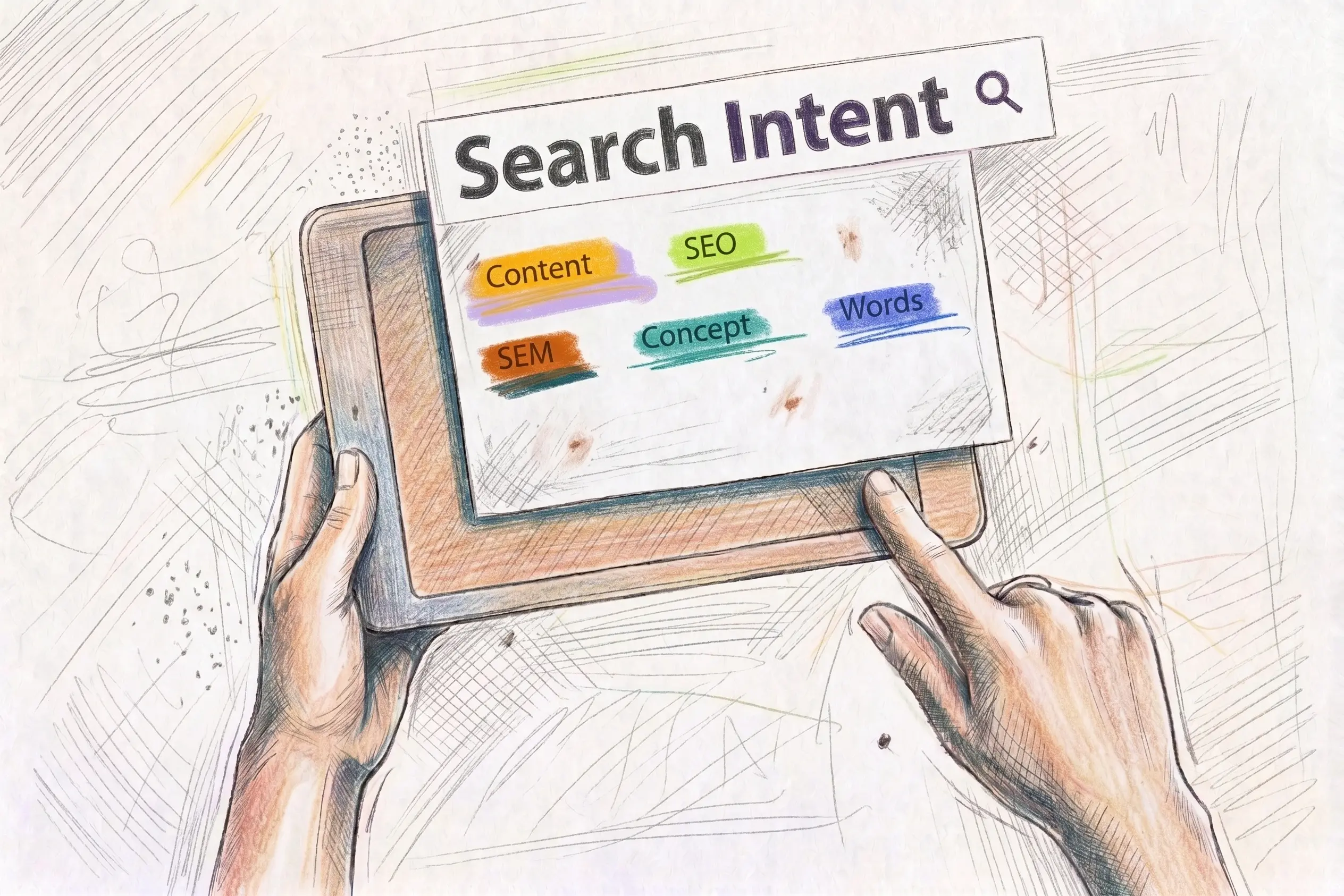
If you’re here at this point, you probably know the basics – of how keywords are separated into 4 categories – informational, navigational, transactional & commercial. But what you might not know is that in today’s AI driven world – search intent is no longer defined into clear categories mentioned above.
We have mixed intent in the picture – that caters to a combination of parent categories – hence optimising your post for keywords is no longer a wise move.
We have come across businesses who report seasonal spikes or a few good performing blogs. But what matters to them is nowhere in sight. I am talking about leads.
Even with monthly investment into SEO scope with a marketing manager to guide you, you might not see satisfactory results you hoped. This is primarily because your search intent is not justifying your target audience’s need.
While SEO and search intent is primarily about brands gaining organic visibility, often, the default subconscious intent is lead generation. Unlike push strategy where you reach out to cold leads; SEO is all about nurturing the incoming leads through integrated marketing efforts.
Here, from start to finish – the search intent plays a pivotal role – taking on the role of target, nurture and next step guidance.
Even with a world-class website embedding your values, and a hefty budget, if the content is answering the wrong question, your efforts are in vain.
Let’s take a fictional (but practical) example of Rahul, who owns a precision manufacturing company in Mumbai.
Like many entrepreneurs, Rahul understood having a website wasn’t enough. He needed to invest in SEO like his competitors. Every month, his team published blog posts about the manufacturing process, company updates and industry news. Google Analytics also showed encouraging numbers.
On paper everything looked promising.
But he and his team weren’t able to answer one fundamental question “Why are these visitors not requesting quotations”..
Traffic had increased,
But business hadn’t.
This is where search intent changes everything.
In this guide, we’ll explore what search intent really means, why it’s become one of the most important concepts in modern SEO, how Google evaluates it, and – most importantly – how you can use it to create content that attracts the right audience.
Let’s get into it.
What Is Search Intent?
Search Intent refers to the reason/purpose behind a question – users make on Google/other search engines or AI. It is the fundamental, building block of how your content is curated and optimised. This could be anything – from finding information (informational intent), comparing options (commercial intent), navigating to a specific website (navigational intent) or making a purchase/action (transactional intent). It could also be mixed intent – which is now leading the search market.
When Rahul observed that he was getting traffic & readers from one of his blog posts, but not customers, he quickly realised – his blog wasn’t answering the intended questions of his target audience.
The problem wasn’t in his blog copy, google algorithm or website design — it was in the search intent – which influenced his comprehending & writing style.
His blog on ‘Industrial Valves’ had a large portion of its audience from engineering students — and not procurement managers or factory owners.
The keyword wasn’t the problem. The intent behind that keyword was.
His ideal customers were searching for things like
- Industrial valve manufacturer in Mumbai
- Custom industrial valves for chemical plants
- High-pressure valve supplier in India, etc.
None of this was present in his copy. He unintentionally wrote for the wrong audience by focusing only on the keywords.
Why Search Intent Matters More Than Keywords
Your customer persona is anything but linear or binary. It’s often complex, where actions are driven by masked desires/needs and assumptions. Here, if you play only by the keyword, your content will most definitely be lost. Even the crawlers who are responsible for crawling and indexing your website/post into relevant categories will by-default play by the keyword (it’s their algorithm!) resulting in your content being undiscoverable – by only touching the surface.
To prevent this, marketers are now working towards mixed intent delivery, where, in addition to providing required information, the post also guides, provides options, answers to most asked queries, includes pros and cons, as well as CTA on what to be done next.
Let’s go back to Rahul.
After understanding the search intent behind queries of his target audience, he can now review his blog and understand that customers weren’t exactly looking for history of valve manufacturing or different types…
They wanted to know
- “Which valve is suitable for handling corrosive chemicals?”
- “Can your valves withstand high pressure?”
- “Do you manufacture custom industrial valves?”
- “And, how quickly can you deliver to Maharashtra?”
By updating his blog with the necessary changes and tweaking the title & meta data, he can now position his blog for both search engines & intent delivery. The readers now constitute a good percentage of people from procurement and factory owners – his initial target audience, – thereby increasing the chances of conversions and requests for quotations.
Customer-first SEO always wins in the long run. Though his revised blog now brings about 800 visitors, down from the previous 2,000, he has started getting leads.
This is exactly what search intent helps you achieve.
Why Businesses Lose Leads When They Ignore Search Intent
Businessmen like Rahul are often caught up measuring the wrong metrics. Though website traffic, clicks, impressions & bounce rate are among the success measuring metrics, often tangible measures like leads & conversions are lost or deliberately left out – when doing organic marketing.
Even with the numbers looking good every month, and Google Analytics showing an upward trend – it doesn’t justify not having any sales meeting from SEO.
Remember, Traffic doesn’t always mean opportunity – if search intent is all jumbled & layered. Your content has to match what people are actually looking for. So, if 800 visitors are bringing in business, compared to past 2000 visitors – which would you prefer?
Search intent bridges this gap by helping businesses create content that attracts not just traffic, but trust, enquiries, and long-term customers. Ignoring this will only hijack your own growth.
The Four Types of Search Intent (With Real Business Examples)
The foundation of any good content or ad copy is rooted in a clear understanding of the four types of search intent. Even with AI reshaping the search marketing landscape, the fundamentals remain the same—in fact, they have become even more important, acting as the roots from which new search experiences branch out.
Let’s look at the types of search intent, with real life examples:
Informational Intent
This constitutes the top of the funnel (TOFU), where readers/visitors are looking to understand a topic. They want guidance, explanation and clarity.
At this stage, trust matters more than selling.
Few of the examples of this search intent are:
- What is search intent
- How does SEO work
- What is automation?
In Rahul’s case, it would be
- How do industrial valves work?
- Which valve is suitable for chemical processing?
If he were to directly push his products, the visitors would likely leave – causing a rise in bounce rate and customer dissatisfaction.
By helping first and selling later, he can position his business as a trusted source.
The content format preferred for this intent are
- Educational blog posts
- Beginner’s guides
- Explainer articles
- Industry glossaries
- Step-by-step tutorials
- Frequently Asked Questions
Commercial Intent
This constitutes the Middle of the Funnel (MOFU), but can extend to BOFU depending on how close the user is in his journey (here it means purchasing or other primary actions defined by a business).
The content format preferred for this intent include – comparison option blogs, honest opinion/review articles, case studies, testimonials, pricing, calculators, and other types of lead magnets.
It is one of the most valuable stages for a business, where they have the opportunity to target TOFU target audience with value-addition offering; as for BOFU – this intent, when properly implemented, helps amplify trust & authoritativeness.
A few examples of this search intent are:
- Best SEO agency in Mumbai
- Ahrefs vs Semrush
- CRM software for startups
- Best accounting software in India
In Rahul’s case, it would be:
- top valve manufacturers for chemical plants
- best industrial valve manufacturer in India, etc.
Navigational Intent
It constitutes the MOFU and BOFU funnel stage, where visitors are looking for a specific brand or page. People searching for this intent already know where they want to go.
Examples include:
- LinkedIn Login
- Zoho CRM
- Google Search Console
- HubSpot Academy
In Rahul’s case it would be
- ‘XYZ Limited Industrial Valve’
- XYZ Limited Mumbai industrial valve manufacturer
Best content formats that does justice to this intent are:
- Homepage
- Service pages
- Login pages
- Contact page
- Brand-specific landing pages
- Knowledge base
Transactional Intent
This constitutes the Bottom of the Funnel (BOFU), where visitors are ready to take action.
The customers are done with the research and are ready for the next step.
Examples include:
- Hire SEO content writer
- SEO services Mumbai, etc.
In Rahul’s case it would be:
- Request manufacturing quotation
- Buy industrial valve online
Best content formats that does justice to this intent are:
- Demo booking page
- Consultation page
- Quote request page
Real Search Intent Examples: What Rahul’s Customers Are Actually Looking For
After Rahul understood the four types of search intent, he stopped categorising keywords based on search volume alone. Instead, he started looking at every search as a conversation with a potential customer.
Rather than asking, “How many people search this keyword?”, he began asking, “What does this person expect to find?”
Below is a sample, tailored content calendar Rahul would implement:
| Customer Search | Search Intent | What the Customer is Really Thinking | Best Content Type | Business Goal |
| What is an industrial valve? | Informational | “Help me understand this.” | Beginner Guide | Builds trust |
| Butterfly valve vs ball valve | Commercial Investigation | “Which one suits my application?” | Comparison Guide | Reduces uncertainty. |
| Best industrial valve manufacturer in Mumbai | Commercial Investigation | “Who can I trust?” | Case Study + Why Choose Us | Builds credibility |
| Industrial valve price India | Commercial Investigation | “Can I afford this?” | Pricing Guide | Filters qualify leads |
| Industrial valve supplier near me | Transactional | “I’m ready to contact someone.” | Local Service Page | Generates enquiries. |
| Request industrial valve quotation | Transactional | “Let’s start the conversation.” | Quote Page | Convert |
Notice something interesting?
Though search revolves around ‘industrial valves’, the intent differs:
- Some are learning
- While others are comparing
- Some are evaluating suppliers
- Others are ready to buy
Your copies should be optimised for customers first, then the keywords. This way, you will not only gain search and AI traffic, but also customers and enquiries.
Search Intent Analysis: The IntentHarbor Framework
At IntentHarbor, unlike other marketing professionals or agencies, we believe search to be human-first, then for the algorithm. With ‘n’ number of websites populating the market, we narrowed on what’s missing – which is – human-centric marketing strategies that have empathy + customisation.
Understanding your target audience is only the first step. What awaits is sitting down and creating tailored blogs, pages or landing pages – that speaks to you, is for your audience and has your values & propositions.
Below is the framework by us, which can be applied to almost any topic/industry or customer journey.
| Step | Ask Yourself | Why It Matters |
| 1. Understand the Human | Who is searching, and what challenge are they facing? | Helps define your actual audience instead of writing for everyone. |
| 2. Discover the Intent | Why are they searching this now? | Reveals whether they’re learning, comparing, evaluating, or ready to act. |
| 3. Deliver the Right Answer | What information would genuinely help them move forward? | Ensures your content satisfies the search rather than simply mentioning the keyword. |
| 4. Build Trust | What proof, examples, or experience can you provide to reduce their uncertainty? | Strengthens credibility |
| 5. Guide the Next Step | What should the visitor do next? | Converts visitors into potential leads. |
How Google Understands Search Intent
Before diving into it, let’s refresh our understanding: in 2026 and beyond – initial SEO practices like keyword stuffing, density optimization & ignoring the intent – are now not only condemned but also penalized by Google.
For a complete guide to writing SEO content that ranks and serves users’ intent — read our guide to SEO Content Writing in 2026 & Beyond.
Google has evolved.
It now uses a sophisticated mix of advanced artificial intelligence, semantic analysis, and user interaction signals to understand the intent behind a search query. This means…. the need to be as natural and expert as possible has become mandatory.
With NLP progression and the introduction of RankBrain in 2015, a typed query is no longer treated as a random string of disjointed keywords. Rather, Google now interprets the query as a whole to understand its context and underlying meaning. It then combines this understanding with systems like the Knowledge Graph and other ranking signals to determine the user’s intent and serve the most relevant results.
This level of understanding has boosted intent satisfaction—leading to better query resolution and fulfilling the user’s intent, whether informational, commercial, transactional, or navigational.
Let’s return to Rahul’s story.
If he were to write a blog, targeting keyword “industrial valve manufacturer in Mumbai” – and is to include context like:
- “What specific sectors do you provide solutions for?”
- “Does your inventory meet global ISO standards?”
- “Are you capable of developing bespoke valve designs?”
- “What raw materials are utilized in your production?”
- “How soon can we expect fulfillment and shipping?”
- “Is global distribution part of your service scope?”
His blog can then have the potential to rank at the top of both the search and AI engines, by-product of which may be lead generation.
Search Intent in the Age of AI Search
With AI advancements and automation redefining efficiency, ranking on Google is no longer the only priority. You need to rank on ChatGPT, Gemini, AI Overview, and Perplexity as well.
Search is no longer about clicking through blue links; it is about receiving synthesised information that makes sense and provides guidance. No matter, it be summarizing information, or explaining technical jargons in simple manner – your copy should cover both the keyword and target audience need – ensuring intent is delivered end-to-end in a close loop.
The more customised and opinionated the copy is, the more it has the potential to fulfill the intent, thereby ranking your website within AI as citations and mentions. The only thing to remember is – keep your content clear, trustworthy and comprehensive enough to become part of the AI generative system.
With this, some businesses nowadays assume that AI search requires an entirely new strategy, which is not true.
The fundamentals remain the same, only the way people search & consume content has changed. For this, your content should genuinely satisfy the intent, goal & guide them towards the next step.
For Rahul, whose priorities now includes AI optimization as well, his strategy will now branch from fundamentals, covering everything from best on-page, off-page & technical optimization to curating easy to understand, direct, well-structured, and genuinely helpful content.
The better you understand human intent, the better your content performs—be it for a person, Google or AI.
Common Search Intent Mistakes Businesses Make
Let’s explore some of the common search intent mistakes businesses make and how to fix it.
- Mistake 1: Starting with Keywords Instead of Customer Problems
- How to fix it: Before researching keywords, identify the questions, challenges, and decisions your ideal customers face. Then use keywords to understand how they search for those answers.
- Mistake 2: Treating Every Visitor the Same
- How to fix it: Create content for different stages of the customer journey and guide readers naturally from one stage to the next instead of expecting every page to generate immediate conversions.
- Mistake 3: Optimising for Search Engines Instead of People
- How to fix it: Write naturally. Answer real questions. Use keywords where they fit, but prioritise clarity, usefulness, and readability above keyword frequency.
- Mistake 4: Ignoring the Questions Customers Ask Before They Buy
- How to fix it: Work closely with your sales and customer support team. They know the questions & problems first-hand. Often the same exact questions are asked by your future customers.
- Mistake 5: Publishing Content Without a Clear Next Step
- How to fix it: Ask yourself: “After reading this, what would genuinely help the visitor next?” That next step might be another article, a downloadable guide, a service page, a comparison resource, or a consultation.
- Mistake 6: Never Reviewing Search Intent as Markets Change
- How to fix it: Schedule periodic content audits. Remember, search intent isn’t static.Neither should your content be.
Final Thoughts: Great SEO Begins with Understanding People
Different businesses have different success metrics. What works for a B2C company might not work for a B2B – which can further be segmented into SaaS, manufacturing, professional services, healthcare, and more.The only constant across all of them is search intent delivery and satisfaction.
Though the intent differs, with even a single keyword having multiple intent across different stages of customer journey; understanding the ‘why’, ‘how’, ‘when’, ‘what’ behind those terms, and audience need associated with it – can truly help understand what they are trying to achieve.
Remember, good SEO begins with understanding the people.
This is also the philosophy behind IntentHarbor. Our approach is simple: Understand the human. Deliver the intent. Earn the trust. Everything else follows. Contact IntentHarbor today for help with search intent classification, choosing the right keywords for your business, writing content that resonates, and ranking at the top of both traditional search and AI search engines.
People Also Ask:
What is Search Intent?
Search intent is the reason why someone searches for something. It explains what they want to find when they type a query into Google or AI.
What is Search Intent in SEO?
In SEO, search intent means creating content that matches what users expect to find. When your content aligns with their intent, it ranks better and, at the same time, helps them.
How do you determine Search Intent?
The easiest way to determine search intent is to search the keyword on Google and analyse the top ranking results. Look at what type of content appears – is it blogs, product page, service pages, videos, or comparison articles. These results reveal what users expect to find, and when you create around it, providing additional value, your post/page starts ranking.
Can Search Intent Change?
Yes, search intent changes when people’s behaviour, trends, technology and needs changes. This is why you need to audit your content one a month minimum to ensure its aligned with the changing intent.
Can one page target multiple Search Intents?
Yes, but only when the primary search intent is clearly defined & addressed. You can address related questions, but ensure it’s done naturally without overpowering the original intent.
What’s the difference between keywords and Search Intent?
A keyword is what someone types into a search engine. Search intent is why they type it.
Why is Search Intent important for businesses?
Search intent helps businesses attract the right audience, not just more traffic. When your content matches what potential customers are looking for, it builds trust. This ultimately improves conversions and generates leads.